Grok Bot Content Creation: What to Automate, What to Keep

Grok Bot content creation splits a creator’s week into two kinds of work: chores that an always-on agent can run on a schedule, and judgment calls that decide whether anyone watches. This article follows one creator’s setup from research to publishing, then tests it against xAI’s documentation, YouTube’s monetization policy, TikTok’s terms and a study on what AI ideas do to creative variety. It ends with a short list of what to hand to the agents and what to keep.
The setup comes from Louise de Sadeleer, who works in growth at the video editor Tella, in a 50-minute interview on Greg Isenberg’s channel published on November 18, 2026. She runs her research, planning, editing preparation and YouTube metadata through Grok Bot, and credits the system with 6,500 new Instagram followers in three months. That figure is hers, with no baseline and no way to separate the agents from her own writing. Her employer also sells the editing connector she demonstrates, which matters later.
Grok Bot runs each agent on a cloud computer that keeps working
xAI launched Grok Bot in beta on August 11, 2026, describing it as a team of always-on agents. According to the documentation, each Bot gets a persistent cloud computer with a browser, a command line and a filesystem, and keeps working when your laptop is closed. Sign-ins and browser sessions survive between tasks.
Three features carry a content workflow, all described on the skills and routines page and the collaboration page:
- Routines start a Bot on a schedule written in plain words, or on an event such as an email to the Bot’s own address, a Slack mention or a webhook call.
- Skills are reusable instructions for a task, shared by all your Bots.
- Group chats put two to six Bots on one shared outcome, where they hand work to each other.
Four weekly routines turn scrolling into a research digest
De Sadeleer’s research layer is four scheduled jobs, each writing to a Notion database. The first visits a list of creators she picked herself and flags posts that did far better than that creator’s usual range. The second reads the videos she saved in a TikTok collection, pulls out the opening lines and sorts them by hook type: contrarian, question, relatable situation. The third builds a trend digest from her paid newsletters, X and a few news outlets, and promotes a topic once enough separate stories mention it. The fourth reports one rising YouTube keyword a week from VidIQ, a keyword research tool.
The fifth habit is not a routine at all. When she sees something worth keeping, she sends the link from her phone and the Bot files it, or turns a post into a screenshot and drops it into the media library of the video it belongs to. That is the part an always-on agent does better than a notes app: capture costs one message.
All four routines run weekly. She tried daily runs and burned through her usage.
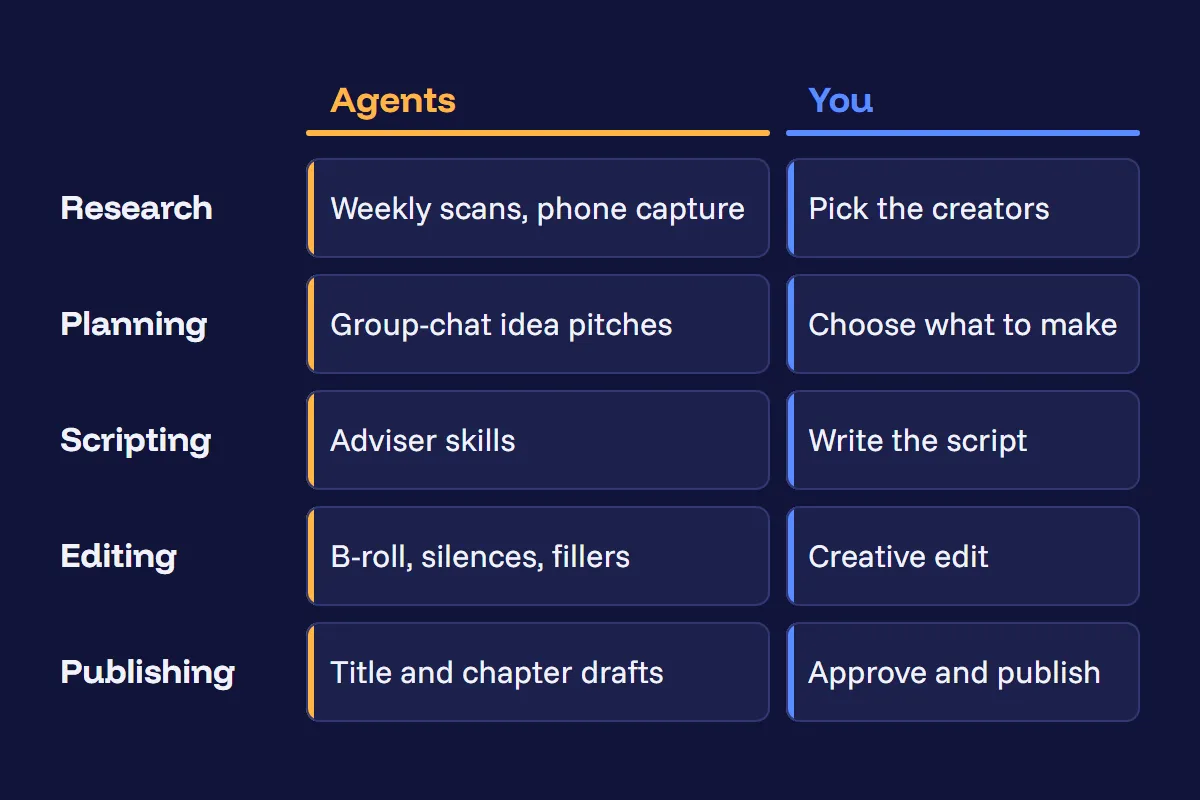 In this setup, the agents collect, file and prepare; the creator picks the sources, writes the script and makes the edit.
The creator list stays hand-picked, because AI curation drifts
The one input she refuses to automate is the list of creators the first routine watches. Her reason, given in the interview:
“whenever AI picks stuff for me, like creators to follow, it diverges so far from who I actually want to be like” - Louise de Sadeleer
Research points the same way at a larger scale. In a study published in Science Advances in July 2024, Anil Doshi and Oliver Hauser had 300 people write short stories, some with ideas from ChatGPT, and asked 600 others to rate them. AI ideas made the stories more novel and useful, mostly for the weaker writers. But stories drafted from a single AI idea were 10.7% more similar to one another than stories by writers working alone, a loss of collective variety the authors frame as a social dilemma (paper).
A routine that mines the same viral outliers as every other creator’s routine pushes in that direction. The research layer is only as distinctive as its sources, so choosing them is the creative act. So is the step after: De Sadeleer reworks a hook about an awkward hug from a parent into one about tax season, keeping the format and changing the subject. No routine makes that move.
Skills capture a method once it repeats, and group chats need roles
Her rule for structure is loose: one Bot per area of work, and a skill once a method has settled through repetition. xAI’s documentation supports the second half. You can ask a Bot to save the process you just used as a skill, and the docs recommend writing down when to use it, the inputs, the steps, how to check the result and where to ask for approval.
Her skills are mostly advisers. One judges bluntly whether an idea is interesting or only feels that way. A hook adviser draws on her saved hooks and her own templates, such as past versus future. A script adviser checks structure. A fourth imitates the feedback her course mentor gives on her scripts, which turns one person’s critique into something she can run before sending a draft. She also needed a skill for something as dull as filing a note in Notion, because the agent kept writing too much.
Her only group chat pairs a producer Bot, which knows her style and her idea backlog, with a trend Bot that behaves like a reporter. Given little more than their roles, they cross her saved ideas with a rising topic and pitch three videos. Roles do the work here. The collaboration documentation adds the catch: Bots in a group message each other with no switch to stop it, and every reply counts toward your usage.
Grok Bot content creation runs on a weekly budget, and November cut it
Each routine run spends usage, and Grok Bot draws on an allowance separate from Grok and Cursor plans. The documented limits are generous for one creator: up to 50 routines per Bot, schedules at least five minutes apart, and 300 runs an hour across all routines. The binding constraint is the weekly allowance, and the documentation does not express it as a number of runs.
That allowance shrank. TechCrunch reported on November 2, 2026 that some users hit their weekly limit unexpectedly over Halloween weekend, and that Elon Musk said serving Grok Bot had cost too much relative to revenue. The article noted that no new limits had been announced. De Sadeleer’s weekly cadence is the practical answer: match each routine to how fast its source changes. A trend digest gains little from daily runs, and a group chat that talks among itself costs more than it looks.
TikTok’s terms rule out the hook-scraping routine
The second routine, a Bot logging into a TikTok account to extract text from saved videos every week, is what TikTok’s terms forbid. The US Terms of Service, last updated July 15, 2026, bar scraping or extracting data or content from the platform with automated systems, bots included, unless TikTok’s US joint venture approves it in writing. Instagram’s terms likewise prohibit collecting information in an automated way without Meta’s express permission.
The risk sits with the account that did the collecting, and with the creator’s main account if that is the one the Bot uses. The capture habit avoids the problem: when you send the Bot a link you chose, it works on your input instead of crawling the platform. Grok Bot also keeps browser logins on its cloud computer and shares them across all your Bots, so each account you sign in becomes available to every agent. That makes access a design decision, as with permissions for an agent a whole team shares.
YouTube monetizes a creative vision, not a template
YouTube renamed its “repetitious content” policy to “inauthentic content” on July 15, 2025, and the channel monetization policies spell out the target: videos that look made from a template, and AI-generated content built on generic templates that adds none of the creator’s own insight. Using AI is not the problem. The same page allows AI to edit scripts or produce a unique background, provided the final video shows the creator’s vision. Reviewers judge the channel as a whole, starting with its main theme and its most-viewed and newest videos.
That is the line De Sadeleer draws by choice. She describes herself as being in the quality camp rather than the volume camp, automates roughly four fifths of her process, and keeps the script for herself. An agent-run channel that also automates the writing is building the exact pattern the policy describes.
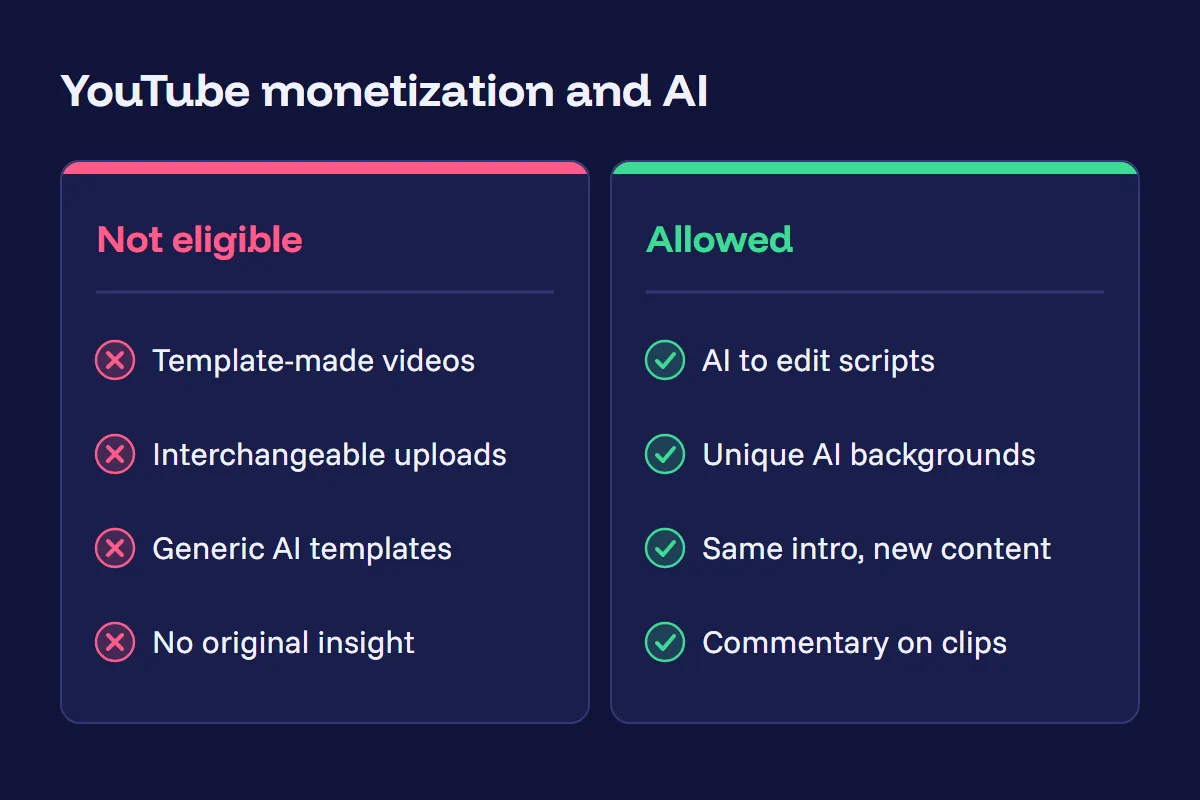 YouTube’s July 2025 policy targets templated, interchangeable videos, not the use of AI for editing or visuals.
Agents prepare the edit; the creative pass stays human
The editing work rests on Tella’s MCP server, a connector that lets an agent use another app’s tools. Tella’s own Grok Bot page states that Grok Bot cannot edit a video file by itself; through the connector it can cut by transcript, remove filler words and silences, add zooms, captions and B-roll, export, and publish. De Sadeleer uses it two ways. Over the days before an edit, she sends posts, screenshots and dashboards into the video’s media library, so the hunt for B-roll is done when she sits down. After a recording session, she asks from her phone for silences and fillers to be gone by the time she is back.
Publishing follows the same split. A YouTube Bot reads the transcript, proposes titles built around a rising keyword, writes the description and the chapter list, and the video goes out from the editor. Treat that last step like any agent that writes to a live account: a draft or an approval first, through a narrow, capped door like the one an ad agent needs. And weigh the editing claims knowing that the person making them works for the connector’s vendor.
Grok Bot content creation checklist: automate six chores, keep four calls
Hand to the agents:
- Capturing ideas, links and posts the moment you see them.
- Weekly scans of sources you picked: outlier posts, newsletters, keyword trends.
- Filing in your notes tool, governed by a skill so the agent does not overwrite.
- Gathering B-roll into the project before the edit.
- The rough cut: silences, filler words, repeated takes.
- Drafts of titles, descriptions and chapters, approved before publishing.
Keep for yourself:
- Which creators and sources the routines watch.
- The script, at least its argument and its hook.
- The creative edit and the final cut.
- Which accounts each Bot can sign into, and what it may publish on its own.
The agents remove the friction around the craft. The craft itself, and the taste that tells a format worth borrowing from one worth avoiding, is what keeps the channel from looking like everyone else’s.