AI Receptionist for Small Business: When Callers Hang Up

An AI receptionist for small business is a voice agent that answers the company line, books appointments and passes urgent calls to a person. Whether callers stay on the line depends less on how natural the voice sounds than on three design choices: saying what it is, keeping a human within reach and limiting what it may promise. This article covers what recent surveys say about caller acceptance, what a Quebec business has to add before switching one on, and seven checks to run first.
James Dickerson owns a mobile diesel repair company in Charlotte, North Carolina, and sells marketing to trades companies. On a recent episode of Greg Isenberg’s podcast, he said he had tried an AI receptionist on his own phone line and dropped it. Callers left voicemails asking whether they had reached a robot, then hung up. One message, as he recounted it:
“Is this a dumb AI thing?” - a caller, as recounted by James Dickerson
His verdict was that these tools do not match how service businesses work. The anecdote deserves attention, because hang-ups are the failure owners fear most. It is also incomplete: he gave no count of the calls the agent handled well, nor of the calls that had gone to voicemail before the test.
An AI receptionist competes with voicemail, not with your best employee
The fair comparison for a small business is not a polished agent against a friendly office manager. It is the agent against whatever happens today when nobody picks up. Invoca, a call-tracking company, analyzed more than 70 million calls across 10 industries for its Lead Conversion Benchmarks Report 2026, published in July 2026. A person answered 56% of them. Counting only calls longer than 15 seconds, which removes misdials and quick hang-ups, the rate reached 65%. Invoca sells AI voice agents, and its data comes from businesses that pay for call tracking, so a three-truck plumbing shop may do better or worse.
The number that matters is your own. If the phone system keeps a call log, two weeks of it show how many callers reach nobody, at what hours, and whether the gap falls after closing time or during the day while technicians are on site. An agent that only covers evenings, weekends and lunch is a smaller project than one that takes every call, and callers who would otherwise get voicemail have less reason to resent it.
Callers accept an AI receptionist when a person stays one step away
Surveys have moved from rejection toward conditional acceptance, although the two discussed here did not ask the same questions. Gartner polled 5,728 customers in December 2023. In results released in July 2024, 64% would have preferred that companies kept AI out of customer service, and 53% would consider moving to a competitor on learning that a company planned to use it. Their top worry was that AI would make a person harder to reach.
Gartner’s August 2026 release covers 3,566 business and consumer customers surveyed in February and March 2026. Half of them say service is easier when a company uses generative AI. In the same survey, 87% called an option to reach a human agent essential. Customers who refused to use AI were asked what would change their mind, and the most frequent answer was being able to switch to a person. The Gartner analyst quoted in the release, Eric Keller, drew the design lesson:
“Service leaders should not use GenAI as a mandatory first step for every issue.” - Eric Keller, Gartner
On a phone line, that becomes one rule. The agent can take the call, but a caller who asks for a person gets one, or a firm callback time, without arguing with the software first.
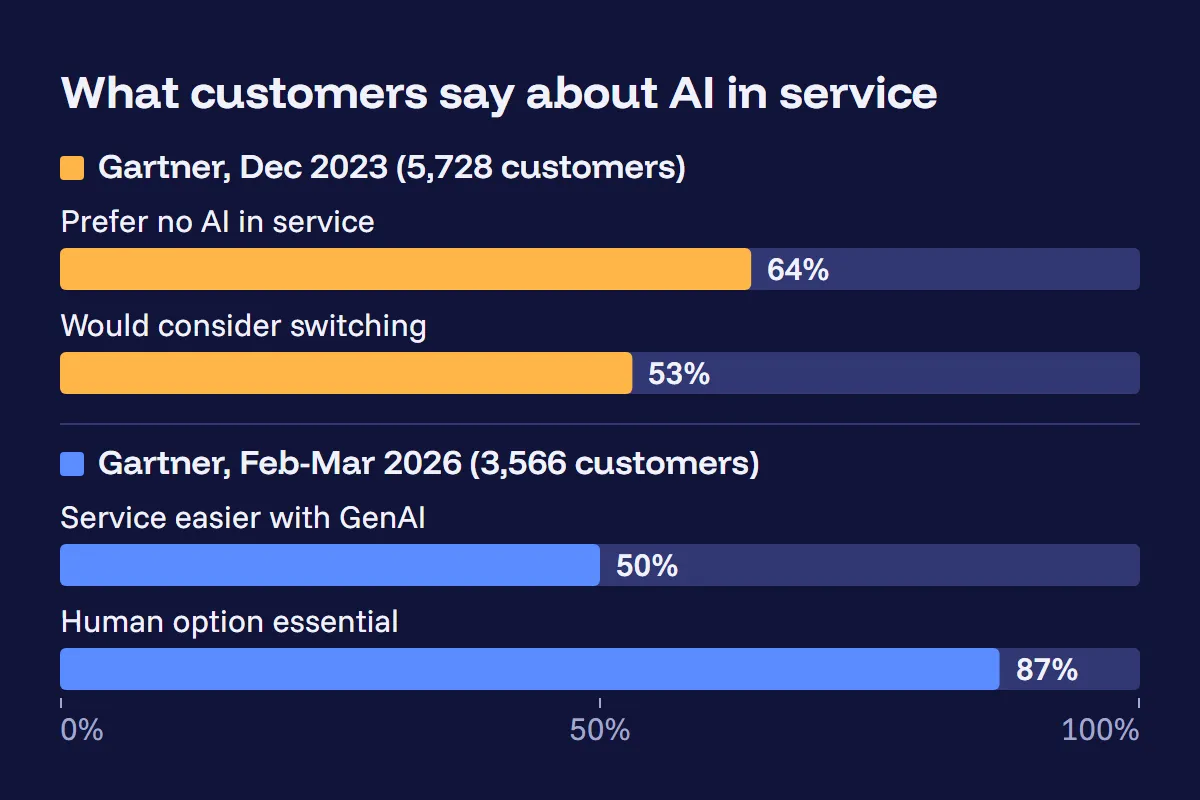 Gartner’s two surveys asked different questions; the constant is that customers want a person within reach. Sources: Gartner releases of July 2024 and August 2026.
Hiding the software is what turns a question into a hang-up
A caller who asks “is this a robot?” has already noticed. What follows depends on how the agent was introduced. If it presented itself as “Sarah at the front desk”, the question becomes a discovered deception, and the caller has reason to doubt the rest, the appointment included. An agent that opens with “you have reached the automated assistant for Dupont Plumbing; say ‘person’ at any time to reach the team” has nothing to be caught at. That is our reading of the surveys and of Dickerson’s voicemails, not a measured result: we found no published study comparing hang-up rates with and without disclosure.
The 2024 Gartner release made a similar point about chatbots: when the bot cannot solve the problem, it should tell the customer it will connect them to an agent, and the agent should continue from where the bot stopped. On the phone, that means the person who calls back has the transcript and does not ask for the address a second time.
We found no Quebec or federal rule that requires a voice agent to announce that it is software. Section 12.1 of Quebec’s private-sector privacy act comes closest: a business that makes a decision based exclusively on automated processing of personal information must say so when it informs the person of the decision. An agent that only books a slot probably does not trigger it; one that turns callers away by postal code might. Ottawa’s Bill C-36, tabled on June 15, 2026, would add transparency duties for automated decisions about individuals, but it is still a bill. Announcing the software is, for now, a design choice, and the cheaper one.
Quebec callers have a right to be served in French
In Quebec, language is not a setting to adjust later. Section 5 of the Charter of the French Language gives consumers the right to receive information and service in French, and section 50.2 requires every business offering goods or services to consumers to respect that right (official text). An agent that greets callers in English, or slides into English when it struggles with an accent, puts the business at odds with both sections.
Several AI receptionist products are designed around the US market. Rosie’s pricing page advertises English and Spanish on every call and says nothing about French, and Goodcall’s pricing page names no language at all (both read on October 29, 2026). Neither page proves the product fails in French; they show that the buyer has to test it. A useful test uses real callers from the region: Quebec accents, street names such as Saint-Hubert or Côte-des-Neiges, someone who mixes French and English in one sentence, and an address spelled out letter by letter.
Recordings and transcripts make the AI receptionist a privacy project
Every call hands the agent personal information: a name, a number, an address, often a description of a problem inside someone’s home. Quebec’s private-sector privacy act, as amended by Law 25, attaches three duties to that (official text):
- Section 8: at collection, tell the caller the purposes, the means, their rights of access and rectification, and whether the information may be communicated outside Quebec. A short spoken notice at the start of the call does it.
- Section 3.3: acquiring an information system that collects or keeps personal information calls for a privacy impact assessment.
- Section 17: before personal information leaves Quebec, including when a provider elsewhere collects or keeps it for the business, the business needs that assessment plus a written agreement.
Unless the vendor states in the contract where audio and transcripts are processed and stored, assume they leave Quebec and that section 17 applies. Office assistants raise the same question, covered in how ChatGPT and Copilot handle business data under Law 25.
The federal privacy commissioner’s guidance on recording customer calls was written for PIPEDA, and the commissioner presents it as best practice for organizations outside that law, which includes most Quebec businesses. It adds two details. The stated purpose should be narrow: a call recorded for quality should not feed marketing. And a system that recognizes repeat callers by their voiceprint collects biometric information, for which express consent may be required.
The business is liable for what its AI receptionist promises
In Moffatt v. Air Canada, decided on February 14, 2024, British Columbia’s Civil Resolution Tribunal held the airline responsible for its website chatbot, which had told a bereaved customer he could apply for a bereavement fare once his trip was over (summary by Deeth Williams Wall). The airline’s defence was that it bore no liability for the chatbot’s answers and that the correct policy sat on another page. The tribunal rejected both arguments and ordered a payment of $812.02 covering damages, interest and fees.
The amount was small; the principle is not. A business answers for what its automated agent tells customers, whatever technology sits behind it. Barry Sookman notes, citing a Canadian Bar Association article, that the Air Canada bot was not developed using AI at all. For a trades company, the risky answers are those a caller will hold you to: a price, an arrival time, whether the warranty covers a repair. They belong in a short list the owner writes and the agent reads from, with “a technician will confirm” as the default for everything else.
Per minute or per caller: the subscription is the small cost
Monthly fees are modest next to the setup work. On their pricing pages on October 29, 2026, Rosie listed $49 a month for 250 minutes, $149 for 1,000 and $299 for 2,000. Goodcall listed $79 a month for 100 unique callers, then 79 cents per extra caller, $129 for 500 and $299 for 2,000. Neither page states the currency. Per-minute plans make long calls expensive; per-caller plans charge the same for a wrong number and a ten-minute booking.
Neither price includes the work that decides whether callers stay: writing the answer list, connecting the calendar, testing French, wiring the transfer to a person and doing the privacy assessment. Count those hours before comparing subscriptions.
Seven checks before an AI receptionist for small business answers your line
- Two weeks of missed-call logs, by hour, so you know which calls the agent is for.
- A first sentence that says it is an automated assistant and how to reach a person.
- One step to a human: a spoken word or a key, and urgent calls forwarded to whoever is on call.
- Answers limited to a written list: hours, service area, booking slots, published prices.
- French by default, tested with callers from your region.
- A recording notice with a narrow purpose, the data location in writing, and a privacy impact assessment if the data leaves Quebec.
- A weekly read of transcripts and hang-ups during the first month.
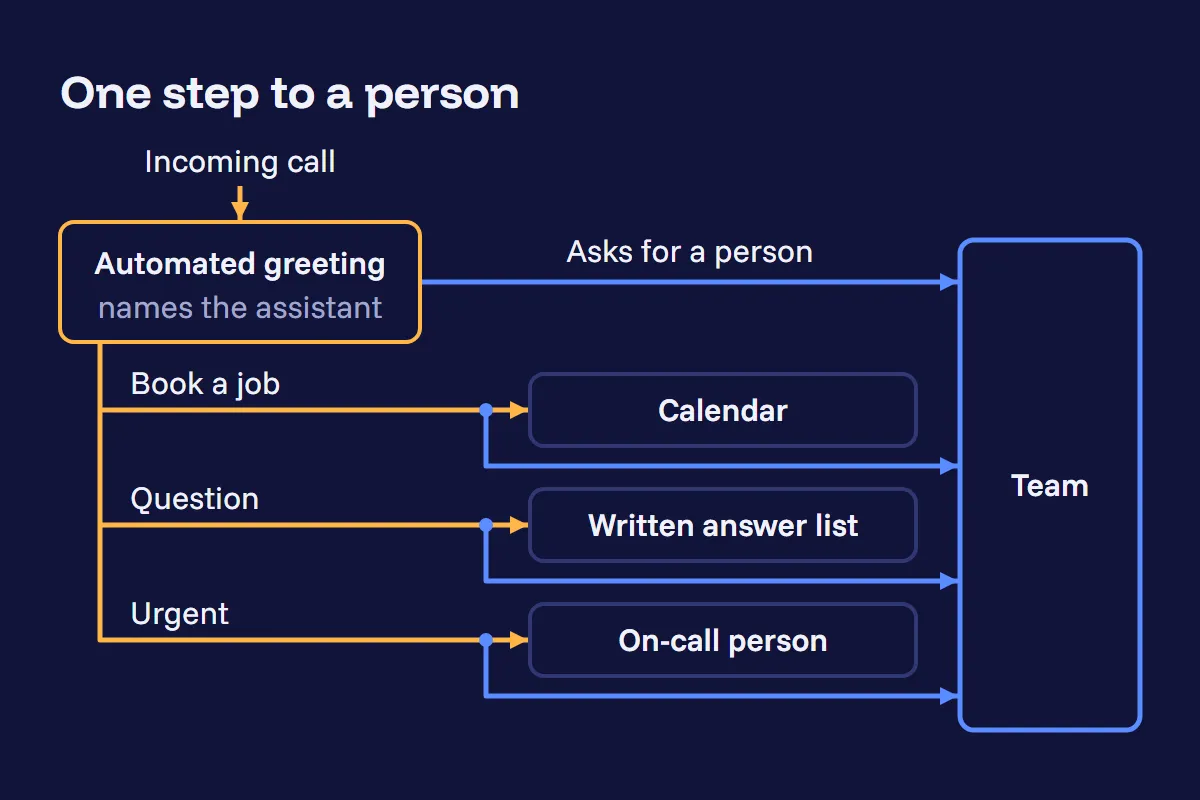 A person is one step away from every branch of the call. Diagram based on the checks above.
Dickerson’s callers were not wrong to hang up on a voice they could not place. An agent that says what it is, sticks to a short list of answers in the caller’s language and hands over without a fight gives them far less reason to.