AI UGC Ads: When a $5 Avatar Becomes a Fake Testimonial

Testimonial advertising is the oldest format in performance marketing: someone who looks like the buyer tells the camera that the product worked. AI UGC ads replace that someone with a generated avatar, a cloned voice and an automated edit, at a price that makes a hundred variations cheaper than a single shoot. This article checks what these ads really cost against what human creators charge, then walks through what US federal rules, a new New York law and Canada’s Competition Act say about an avatar that speaks like a customer, and ends with six rules for using one safely.
In a November 2026 episode of Greg Isenberg’s podcast, growth marketer Cody Schneider ran the whole pipeline live. A coding agent wrote the script, a cloned voice read it, ByteDance’s Seedance model animated a reference photo to match the audio, and a final pass upscaled the clip and laid motion graphics on top. The projected bill was about $4.75, roughly $5 with the graphics, against the $300 to $500 he says a creator, an editor and a motion designer used to cost. Schneider founded Graphed, which sells the infrastructure he demonstrated, so the numbers deserve a check. The episode also never mentions the law, and that gap matters more than the price.
AI UGC ads cost dollars, but human creators cost less than claimed
The $5 figure holds up. fal, one of the hosts that resells Seedance, published its rates for version 2.5 on August 18, 2026: billing runs on output tokens and works out to about $0.22 per second of 480p video and $0.47 per second at 720p, with audio included (fal). A 20-second clip therefore costs about $4.41 at 480p and $9.46 at 720p, before the voice clone and the upscale. Rendering small and enlarging afterwards, as Schneider described, is exactly how the bill stays near five dollars.
The human side of the comparison is where the episode stretches. Sideshift, a creator marketplace Schneider says his team uses, puts a typical UGC video at $50 to $300, with most brands paying $100 to $200 (Sideshift, updated August 27, 2026). Influee, another marketplace, gives an average of $150 to $212 and adds 30 to 50 percent when the brand wants usage rights for paid ads (Influee, April 2025). Schneider himself mentioned paying creators about $40 a video through Tribe.
So the gap is real but closer to ten or forty times than a hundred. That is still enough to change how many variations a small brand can afford to test. It also means the cost of the avatar is no longer the interesting number. The interesting number is the penalty.
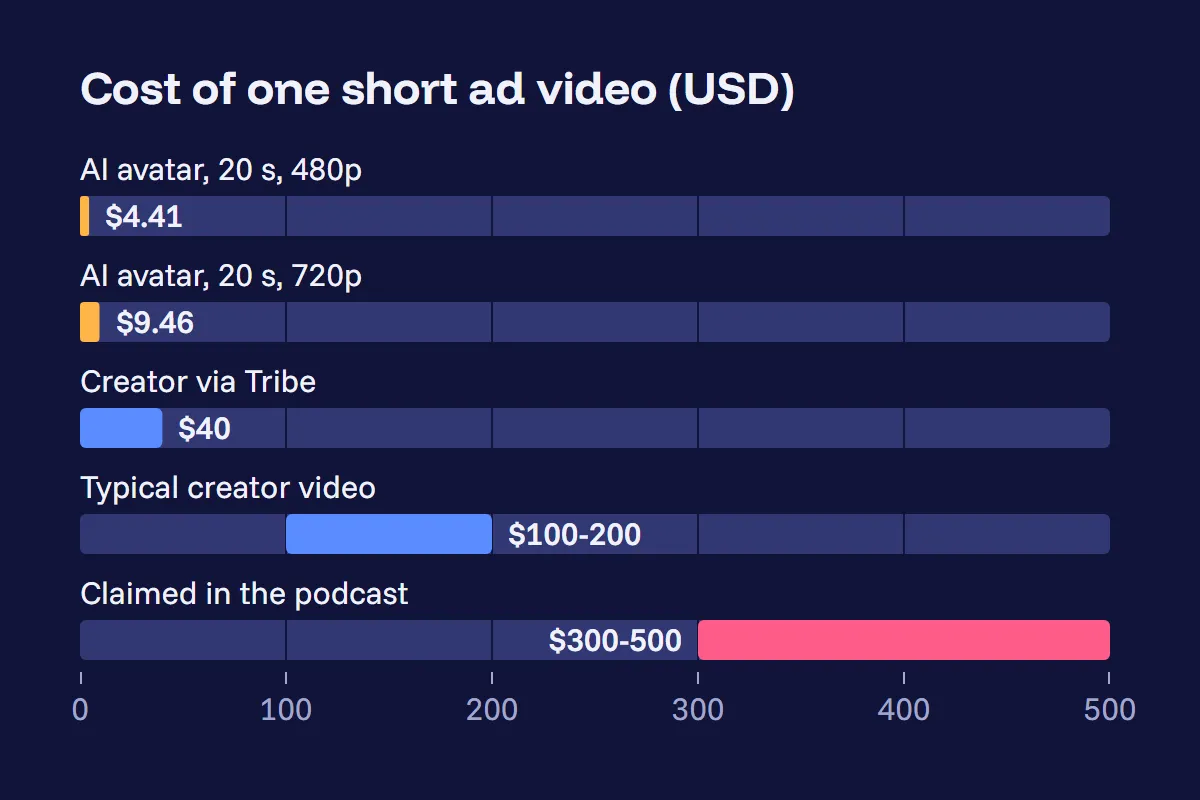 An AI avatar clip costs a few dollars, but typical human creator rates sit well below the podcast’s $300 to $500. Sources: fal (August 2026), Sideshift (August 2026), Cody Schneider.
An avatar posing as a customer is a testimonial from no one
The Federal Trade Commission’s rule on consumer reviews and testimonials, 16 CFR Part 465, was announced on August 14, 2024 and took effect that October. It bans creating fake consumer testimonials and bans disseminating them when the business knew or should have known they were false. The announcement names the case of a generated persona directly, describing testimonials that misrepresent that they are:
“by someone who does not exist, such as AI-generated fake reviews.”
- Federal Trade Commission, final rule announcement, August 14, 2024
An avatar that says “I switched three months ago and my skin has never been better” describes an experience no person had. The advertiser chose the script, so the knew-or-should-have-known test is met by construction. The rule is what lets the FTC seek civil penalties, which stood at up to $53,088 per violation when the agency sent warning letters to ten companies on December 22, 2025, its first public move under the rule (Kelley Drye).
The FTC’s actor rule already covered avatars
Long before generated video, the FTC’s Endorsement Guides dealt with paid actors. Section 255.2(c), in the version revised in July 2023, says that an ad presenting its endorsers, openly or by implication, as real customers should use real customers in both sound and picture, or else:
“clearly and conspicuously disclose that the persons in such advertisements are not actual consumers of the advertised product.”
- FTC Endorsement Guides, 16 CFR 255.2(c)
The Guides are advisory, but they describe how the FTC reads deception under Section 5 of its Act. An avatar is an actor who has never touched the product, and the Guides never banned actors. They banned passing actors off as customers. The deciding question is therefore the framing, and “by implication” carries weight: first-person claims of use, a selfie shot in a bathroom, a first name in the caption and the shaky phone look that defines UGC all tell the viewer this is a buyer. The same avatar reading “here is what the app does” as a presenter is an ordinary ad that needs only the usual proof for its claims.
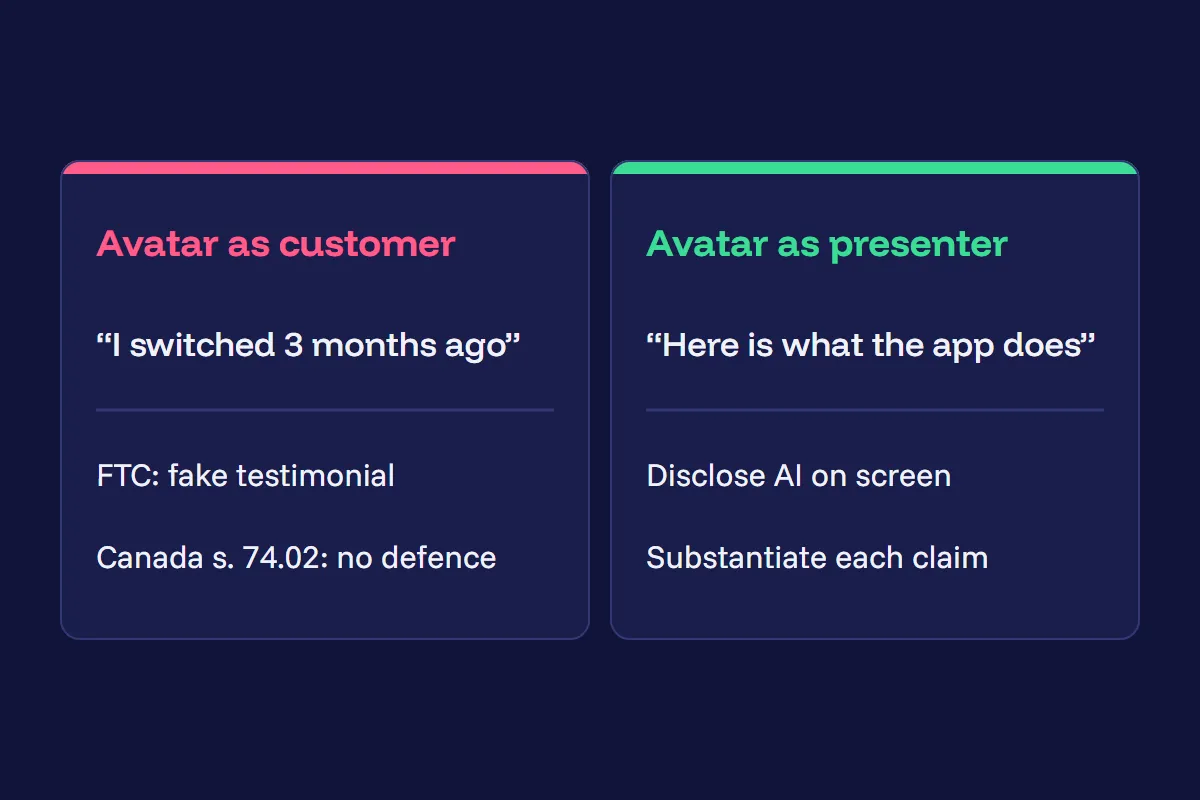 The same avatar is a fake testimonial as a customer and a normal ad as a presenter. The script decides which one you are publishing.
Rytr shows the FTC pursues the advertiser, not the AI tool
In December 2025, the Commission voted 2-0 to reopen and set aside its 2024 order against Rytr, which had barred the company from selling an AI service that generated reviews and testimonials. It found that the complaint did not support a Section 5 violation and that the order burdened a young market, citing the administration’s AI Action Plan (Parker Poe, December 30, 2025).
That decision protects the people who build generators. It does not touch the review rule, and it leaves liability where the ad runs. When an agent produces and uploads a hundred avatar videos through a marketing API, the business whose name is on the ad account is the one that disseminated them.
New York requires a label on synthetic performers since June 2026
New York’s synthetic performer law, bill S.8420-A, was signed on December 11, 2025 and took effect on June 9, 2026 (Governor of New York). It defines a synthetic performer as digitally created media that appears as a real person, and requires whoever produces or creates an ad to disclose one conspicuously. Penalties are $1,000 for a first violation and $5,000 after that, with exemptions for audio-only ads, AI used only to translate a human performer, and expressive works such as films (Hunton).
The fines are small, but this is the first state statute aimed squarely at the format. It also stacks with the federal rules instead of replacing them. A label satisfies New York, yet a labelled avatar claiming three months of use still describes an experience nobody had.
Canada’s Competition Act leaves an avatar testimonial no defence
Canadian law is blunter. Section 74.02 of the Competition Act makes it reviewable conduct to publish a testimonial to promote a product unless the advertiser can show that the person who gave it made or published it first, or approved it in writing before publication, and that the ad matches what they said. An avatar has no person behind it, so neither branch of the defence is available.
For a corporation, the court can order a penalty up to the greater of $10 million, or $15 million for a repeat order, and three times the benefit from the conduct. When that benefit cannot be reasonably measured, the cap becomes 3 percent of worldwide gross revenues (section 74.1). In a September 23, 2026 submission to Ottawa’s AI transparency consultation, the Competition Bureau said the law contains no carve-out for AI, listed fake endorsements among the practices AI amplifies, and warned that labels alone may not be enough (BLG, October 15, 2026).
Self-regulation points the same way. Clause 7 of the Canadian Code of Advertising Standards requires testimonials to reflect the genuine, current opinion of the person giving them. Ad Standards’ October 2025 influencer guidelines add that a virtual influencer cannot vouch for something it cannot experience, and suggest tags such as #AIcreated (Bennett Jones, December 9, 2025).
Quebec adds a rule on the input side. Article 36 of the Civil Code of Québec treats the use of a person’s name, image, likeness or voice for purposes other than legitimate public information as an invasion of privacy. Starting from a real creator’s photo, as Schneider’s workflow does, or cloning a real voice, needs that person’s written consent, and the licence should name AI derivatives explicitly.
Meta’s AI info label is not your disclosure
Meta does label generated ads, but not in a way that settles the question. Ad images made or significantly edited with its own generative tools, or with third-party AI tools, receive an “AI info” label shown in the “About this ad” screen behind the three-dot menu, and sometimes next to “Sponsored” (Meta). A June 1, 2026 update extended automatic detection of third-party tools through industry-standard signals (Meta). Self-disclosure by the advertiser is mandatory only for social issue, election and political ads.
For a commercial avatar ad, then, the label depends on detection and usually sits one tap away from the video. That falls short of “clear and conspicuous”, and the Bureau’s warning applies directly: a label does not repair a misleading claim. The disclosure that protects the advertiser is the one inside the video itself.
AI UGC ads that stay legal: six rules
Schneider proposed a human approval gate before anything goes live and an agent that scores each creative. Both ideas are sound, and the legal check belongs in that gate. These six rules cover what it should test:
- Cast the avatar as a presenter. No first-person claims of use, no “I switched”, no before-and-after story told by someone who does not exist.
- Give customer claims to real customers. A real review read by an avatar still needs the reviewer’s written approval in Canada, and the ad must match what they wrote.
- Disclose inside the video, at the start. A short on-screen line such as “AI-generated presenter” works for New York, the FTC Guides and Ad Standards at once. Do not rely on a platform label.
- License every real face and voice. Written consent that names AI derivatives, for reference photos and voice clones alike, keeps you clear of article 36 in Quebec.
- Keep proof for every claim. Whatever the avatar says is the advertiser’s own claim, and needs the same substantiation as a print ad.
- Log which ads are synthetic. An agent that ships a cohort of thirty variations should record which ones used an avatar, so disclosure and takedown are a query, not an investigation.
The principle is the one that keeps callers on the line with an AI receptionist that says it is software: people accept the machine when it does not pretend to be a person. An avatar that sells is fine. An avatar that claims to have bought is a testimonial nobody gave, and in Canada it comes with no defence.