Free AI Courses From OpenAI, Anthropic and Google Compared
Free AI courses from the companies that build the models have become the usual starting point for anyone who wants to use AI at work. This article compares what OpenAI, Anthropic, Google and Microsoft actually offer as of October 2026: the content, the hours, the price, the credential at the end, and how much of each course is a tutorial for the vendor’s own product. It closes with a way to pick one without collecting badges from all four.
The comparison starts from Tina Huang’s AI learning roadmap, published on 2026-10-19, which sorts learners into six profiles and gives each its own reading list. For the shared foundation, she lists Google’s certificates on Coursera, Andrew Ng’s courses, the University of Helsinki’s Elements of AI, and the free catalogs of Anthropic and OpenAI, warning each time that a vendor’s course leans toward its own tools. Her advice on how many to take is blunt:
“You just need to choose one and you would get all the foundational skills that you need.” - Tina Huang
Part of her video is sponsored by Coursera, which hosts the Google program she says she would pick today, and she is open about that program’s Google lean. What a list cannot show is how large the lean is in each catalog, and what the certificate at the end is worth. The vendors’ own pages answer both questions, sometimes more candidly than expected.
OpenAI names the product behind each Academy course
OpenAI is the most explicit of the four. Its help article on Academy courses, read on 2026-10-22, lists fourteen courses in a table with a column titled “OpenAI product focus” (OpenAI Help Center). Thirteen of them name a product: ChatGPT, ChatGPT Work, the OpenAI API or Codex. The only exception is AI Leadership, a three-hour course on business priorities, governance and an adoption roadmap, described as tied to no single product.
The entry point is a three-course path for people who use AI at work, announced on 2026-06-12 with BCG, Accenture and BBVA as partners (OpenAI). AI Foundations covers prompting, context, reviewing output and responsible use in 60 to 75 minutes. Applied AI Foundations turns a recurring task into a workflow with review points, and Agents and Workflows practices handing structured tasks to an agent. Each of those two is estimated at 75 to 90 minutes, so the whole path fits in an afternoon: 3.5 to 4.25 hours.
Everything is free. A ChatGPT account is required to enroll, and the courses run on Gradual, a third-party learning platform. A badge, issued through Accredible, requires passing an assessment of 10 to 20 questions with a score of 80% or more, and finishing all three courses of a path adds a certificate of completion. On what those documents mean, OpenAI leaves no room for doubt:
“These badges and certificates of completion are not certifications and do not guarantee eligibility for a future certification.” - OpenAI Help Center
Anthropic splits Claude Academy into product courses and AI fluency
Anthropic’s catalog goes by the name Claude Academy, at academy.claude.com, with the courses hosted on Skilljar. As of October 2026, the catalog lists about two dozen courses, and they divide cleanly. Thirteen teach a product: Claude 101, Claude Code, Claude Cowork, the Claude API, the Model Context Protocol, Claude on Amazon Bedrock and on Google Cloud, and a guide to rolling out Claude Enterprise. Ten teach general skills: AI Capabilities and Limitations, plus an AI fluency course offered in versions for educators, students, nonprofits, small businesses, builders and creative work.
The flagship of the second group, AI Fluency: Framework & Foundations, runs 14 lessons and one quiz for about four hours, according to the course page on Claude Academy. Anthropic built it with two academics, Joseph Feller of University College Cork and Rick Dakan of Ringling College, and released it under a Creative Commons license (CC BY-NC-SA 4.0), which lets a school or a company reuse it for noncommercial training. Its framework rests on four competencies: delegation, description, discernment and diligence. The companion course on capabilities and limitations adds another three and a half hours. Claude 101, by contrast, is a tour of the product: projects, artifacts, skills, connected tools, research mode.
Registration is free and needs only a Skilljar account, not an Anthropic one. A final assessment leads to what the course pages call either a certificate of completion or a completion badge. In a post dated 2026-08-20, Anthropic says it organizes the Academy around problems learners need to solve rather than around features, and that some of the material is deliberately independent of any product or model (Claude blog). The fluency courses bear that out. The product courses are what their titles say.
Google’s AI certificates cost $49 a month and teach Gemini
Google’s offer is the odd one in a comparison of free courses, because it is not free. Google AI Essentials, a five-course series on Coursera, costs $49 a month in the US and Canada after a seven-day trial, and its FAQ answers the question directly: the course cannot be taken for free, although financial aid exists (Coursera). Its five course estimates add up to 8 hours, even though the page’s summary panel says 4. The page counts 2,044,479 enrolled learners. The tools it lists are Gemini and Google Sheets, even if the FAQ says learners may use whichever AI tool they prefer.
The newer Google AI Professional Certificate has eight courses, from AI fundamentals to building and deploying an app, at the same monthly price (Coursera). The page, marked as updated in August 2026, shows 1,653,338 enrolled. It is inconsistent about time too: the header says 8 hours, while the eight course estimates add up to 13. The tools are Google’s throughout: Gemini and its Deep Research mode, Gemini inside Docs, Sheets, Slides and Meet, and Google AI Studio for the two app courses. Enrollment comes with a three-month trial of Google AI Pro, Google’s paid Gemini subscription. The labs, again, accept any browser-based generative AI tool.
Essentials rules out free access outright, and the certificate page describes no free audit. A learner who moves quickly can finish Essentials inside the trial week. The professional certificate is more realistic as one paid month.
Microsoft’s LinkedIn path is rewritten twice in seven weeks
Microsoft’s entry, Career Essentials in Generative AI on LinkedIn Learning, shows how fast these courses move. Huang described it as roughly six hours long and out of date, with a refresh announced. The page now lists five courses and four hours of content, with one note saying the path was updated on 2026-10-02 and another saying it will be updated again on 2026-11-16 (LinkedIn Learning). Learners who have not finished by the second date may need extra courses to earn the certificate.
One of the five, Learning Microsoft 365 Copilot for Work, is a product course. The others cover general concepts, AI literacy and ethics. The oldest was released in May 2023 and the newest in September 2026. Huang listed it as free, but the page shows no price and sends visitors to a LinkedIn Learning sign-up, so check before counting on it.
Elements of AI is the neutral benchmark
The useful point of comparison is a course with no product to sell. Elements of AI, created by the University of Helsinki and the Finnish company MinnaLearn, is a free introduction to artificial intelligence for non-experts. Its first part needs no programming, and its second, on building AI, recommends basic Python (Elements of AI). The home page claims over 2 million sign-ups, without a date. The Finnish Center for Artificial Intelligence reported one million across 170 countries in May 2023 and put the course at about 30 hours of work (FCAI, 2023-05-23).
Thirty hours against four is the real difference. Elements of AI explains what AI is and how it works. The vendor courses explain how to work with one particular assistant. Neither replaces the other, and the vendor course is the one that pays off the next morning at work.
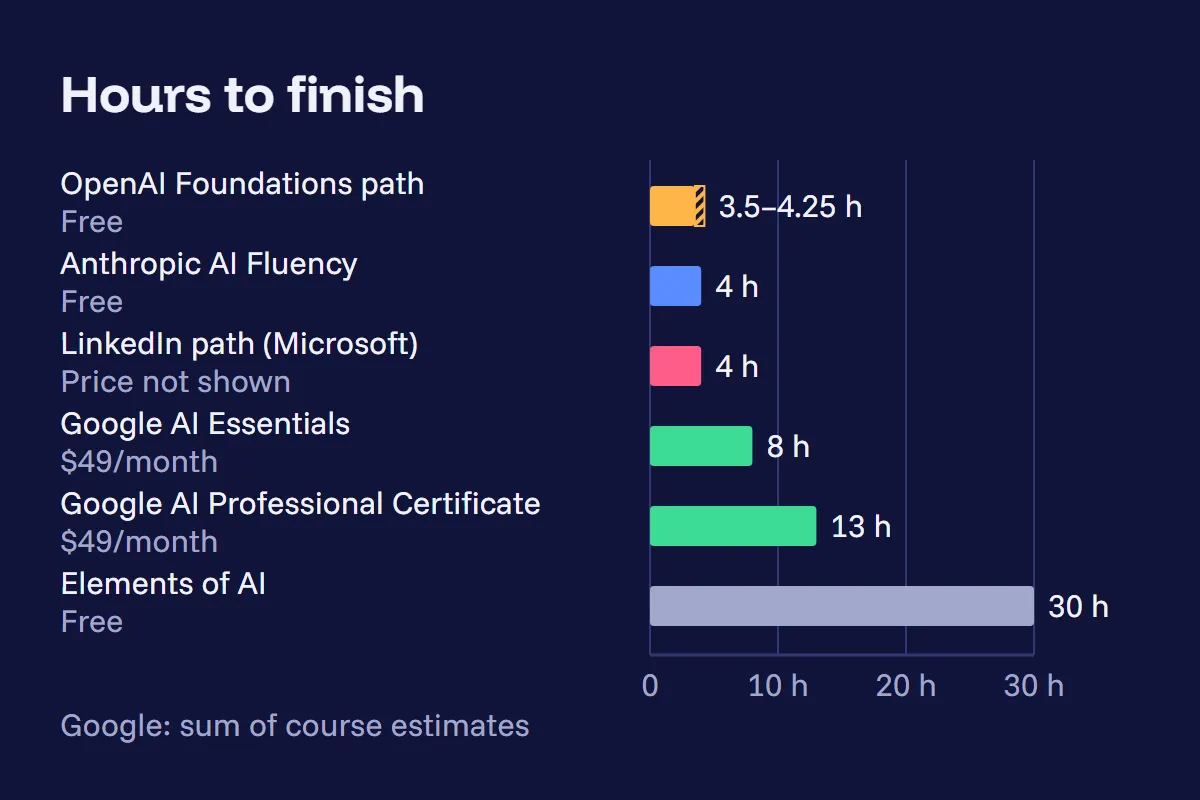 The vendor courses fit in an afternoon or two, the neutral one asks for about 30 hours. Sources: course pages read on 2026-10-22, FCAI for Elements of AI.
The habits every vendor teaches are the part that transfers
Line up the foundation courses and the same four habits appear under different names. OpenAI’s courses page sums up what its learners practice as giving clear instructions, adding context, reviewing outputs, deciding what to delegate and staying in control of the work (OpenAI Academy). Anthropic’s four competencies cover the same ground. Its lesson pages define description as communicating intent to the AI, discernment as evaluating what it produces and how, diligence as taking responsibility for the result and being open about the AI’s part in it, and delegation as deciding which work stays human, which is shared and which the AI handles alone. Google’s Essentials has a course on prompting and another titled Use AI Responsibly. The vocabulary is branded. The content is not.
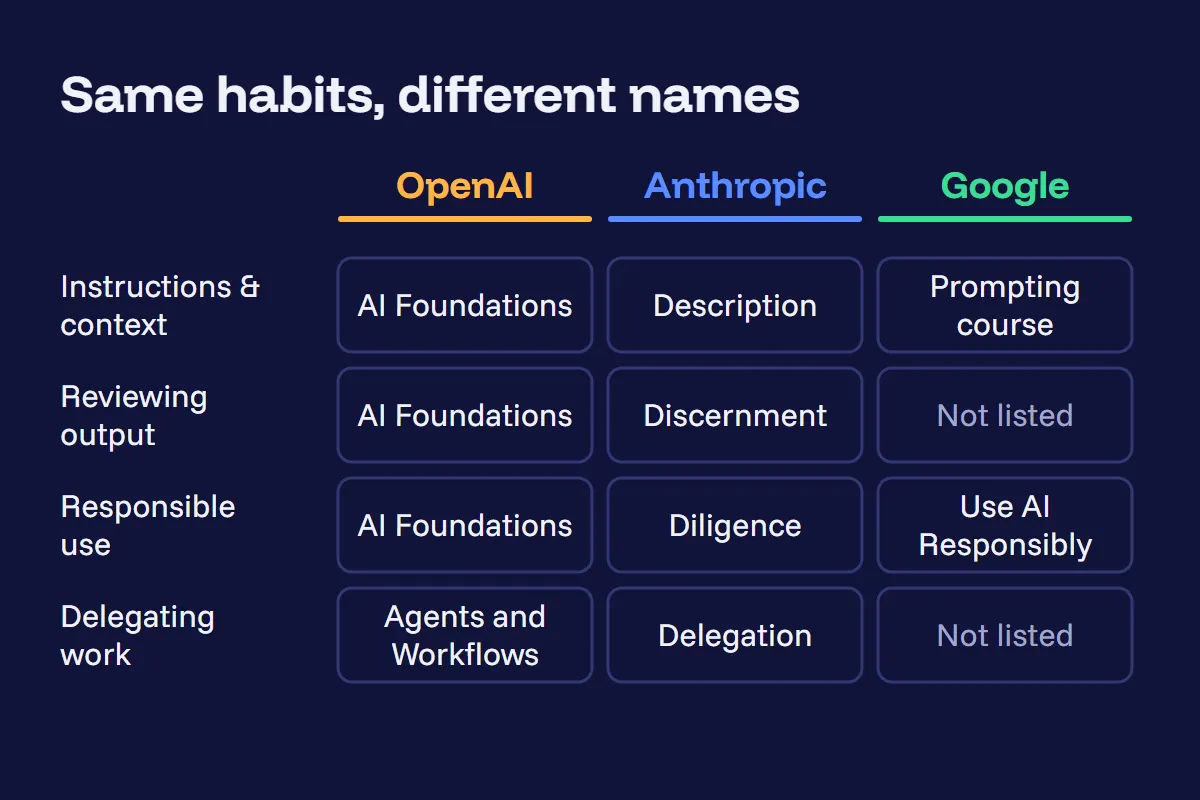 Each vendor teaches the same core habits under its own names. The Google column comes from the AI Essentials course titles.
That convergence is the strongest argument for Huang’s advice. If every foundation course teaches the same habits, a second course mostly teaches a second interface. The product part of each course ages with the product: a lesson on where a feature sits in Gemini or Claude holds until the next redesign, while the habit of checking an answer before using it does not expire. It is the same split between what a release deletes and what lasts that decides which parts of an AI agent harness survive the next model release.
A badge records that you finished, not what you can do
None of these documents is a professional credential, and OpenAI is the only vendor that says so in plain words. Anthropic issues a certificate or badge after a final assessment. Google calls its series a professional certificate, but it is a Coursera subscription product, not an exam set by an independent body. The LinkedIn path awards a certificate tied to a version of the content that changes every few weeks.
What follows is my view, not a finding from any of these sources. To a hiring manager, a badge shows that someone spent a few hours on a course. A short written account of one real task moved to AI, with what was checked and what went wrong, shows far more, and it costs nothing.
How to choose among the free AI courses
The tool you already use at work should decide the course, because that is where the product lessons pay off. A practical order, as of October 2026:
- ChatGPT at work: OpenAI’s three-course Foundations path, free, about four hours.
- Claude at work: Claude 101 for the product, then AI Fluency: Framework & Foundations for the habits, free, about four hours for the second.
- Gemini and Google Workspace: Google AI Essentials, finished within the seven-day trial if possible, or the professional certificate if you plan to build apps in Google AI Studio.
- Microsoft 365 Copilot: start the LinkedIn path only if you can finish it before the 2026-11-16 revision, otherwise wait for it.
- No tool chosen yet, or a need to understand the machinery: Elements of AI, free, about 30 hours.
Take one, not four. Then spend the hours saved on real work with the assistant, which is where the four habits either stick or fade.