AI Plant Disease Diagnosis: How Far to Trust a Chatbot
AI plant disease diagnosis means asking a model to say what is wrong with a crop from a picture, and it no longer requires a specialised app: any grower can send a leaf photo to Claude, ChatGPT or Gemini and get a confident answer in seconds. This article looks at how often those answers are right, using benchmarks published in 2025 and 2026, why a photo alone cannot settle many crop problems, and where a lab test, a soil analysis or an agronomist still has to come in, with Quebec’s rules as the worked example.
Anthropic made the optimistic case on 17 November 2026 with a three-minute video, A season on the farm with AI. A biologist from Vienna, now on her partner’s family farm in Slovenia, had lost two sweet potato seasons in a row. In the third, about a third of her mother tubers stayed dormant, so she photographed them and asked Claude for help. It came back with a sprouting protocol. Later the young plants showed nutrient deficiencies, and the protocol had to be reworked. She describes the outcome as her best harvest so far.
“When I started using Claude, I had absolutely no deep understanding of how AI worked.” - the grower, in Anthropic’s video
Anthropic’s sweet potato video shows an adviser, not a diagnosis
The story is believable, and franker than most advertising: she admits that many ideas she and the chatbot produced were unrealistic, and that her partner had to carry them all out. It remains a vendor’s film about one success. The protocol never appears on screen, nothing compares it with what a standard growing guide or a local adviser would have recommended, and the single weight she reads off a scale has no reference point.
The revealing detail is the second problem. The deficiency was not prevented by the first answer, and as far as the video shows, it was spotted by watching the plants, not by a photo diagnosis. That is the pattern the research keeps finding. A general chatbot is a good partner for weighing options and planning the next step, and a weak judge of what is wrong with the plant in front of you.
AI plant disease diagnosis scores 30% at best on open questions
The widest recent test comes from Earl Ranario and J. Mason Earles at UC Davis, in a study revised in May 2026. They ran general vision-language models against 26 agricultural image collections from the AgML project: 121 classes and roughly 248,000 pictures covering plant diseases, pest damage, and crop and weed species.
When the models had to name the problem freely, as a grower would ask, GPT-5 and Gemini 3 Pro got about 21% exactly right. Letting a second model grade the meaning rather than the wording lifted Gemini 3 Pro to 30% and GPT-5 to 25%. Every model stayed below the score you would get by always naming the most common class in each collection. Given a multiple-choice list instead, Gemini 3 Pro reached about 62%, GPT-5 54% and Claude Haiku 4.5 34%. A YOLO11 classifier trained separately on each collection averaged 97.8%.
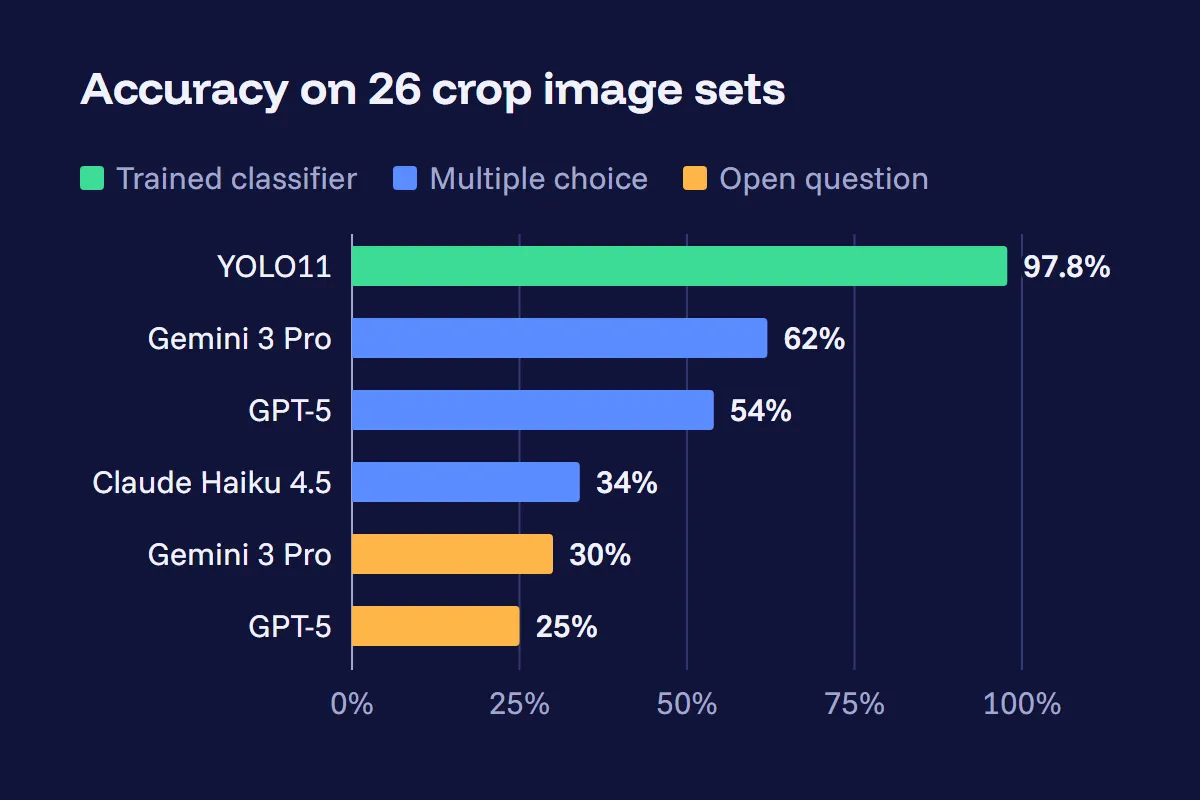 The best general model doubles its score when it picks from a list, and still trails a trained classifier by a wide margin. Source: Ranario and Earles, UC Davis, 2026.
Two caveats matter. To keep costs down, the commercial models were scored on a random tenth of the images. And Claude Haiku 4.5 is Anthropic’s small, fast model, so the result says little about the larger Claude the grower probably used. The authors’ verdict on the general models is still blunt:
“not yet suitable as standalone agricultural diagnostic systems” - Ranario and Earles, UC Davis
A short list of suspects roughly doubles chatbot accuracy
The gap between open answers and multiple choice is the most useful finding for a grower. A model asked to pick among a few named candidates does far better than one asked to invent the answer. The UC Davis team also slipped a “none of the above” option into the multiple-choice rounds, and it was the correct pick in 30% of them, which tests whether a model will admit that no listed cause fits.
A team credited to Zhejiang University pushed the idea further with ChatLD, described in a November 2025 release about a paper in Plant Phenomics. Instead of training an image model, they gave GPT-4o written descriptions of each disease’s symptoms and rules for scoring a photo against them. On six tomato diseases, that framework reached 88.9%, where GPT-4o used directly managed 45.9% and Gemini 1.5 Pro 56.1%. On field photos from the PlantSeg dataset, with cluttered backgrounds and overlapping leaves, it held 77.3%. The models are now a generation old and the test covered one crop, so the figures date quickly. The method does not: tell the model which problems are plausible and how to tell them apart.
Specialist apps also fail on photos unlike their training images
Dedicated plant apps are not automatically the safer choice. The classic warning is Mohanty, Hughes and Salathé’s 2016 paper in Frontiers in Plant Science. Their network learned from 54,306 PlantVillage images covering 14 crops and 38 crop-disease pairs, each a single leaf shot on a plain background. On held-out pictures from that same collection it scored 99.35%. On 121 photos gathered from other sources it fell to 31.4%.
The paper is ten years old, but the lesson holds: the UC Davis YOLO11 classifier scored above 95% on every collection because it was tested on images resembling those it learned from. Your field, light, camera and crop variety are not in anyone’s validation split. When an app advertises 95% accuracy, the useful question is: measured on which photos?
Models call sick leaves healthy, and nothing flags the error
Wrong answers do not announce themselves. Researchers at Texas A&M AgriLife tested four small open models in May 2026 on tasks that included sorting tomato leaves into bacterial spot or healthy, a two-way choice. Without examples the models scored between 63% and 75%; with a few labelled examples the best reached 86.8%. The errors ran in both directions: diseased leaves were declared healthy, and infections were invented on clean foliage.
The same paper uses yellowing leaves as its warning case. Chlorosis can come from a nutrient shortage, from drought or from a pathogen, and a model that reads it wrongly sends the grower toward the wrong fertiliser or the wrong irrigation schedule. Right or wrong, the answer arrives in the same assured tone.
A photo cannot separate a nutrient deficiency from a disease
Extension specialists have long said what the benchmarks now measure. A University of Delaware fact sheet revised in March 2025 gives two rules of thumb. Damage from insects or bacteria tends to be lopsided, while a deficiency usually shows evenly across the plant. Mobile nutrients such as nitrogen, phosphorus, potassium and magnesium show up first on older leaves; immobile ones such as calcium, boron, iron, manganese, zinc and copper first appear on new growth. It then warns that many deficiencies look alike, that they are easily confused with herbicide drift or disease, and that a tissue test is often needed to name the nutrient.
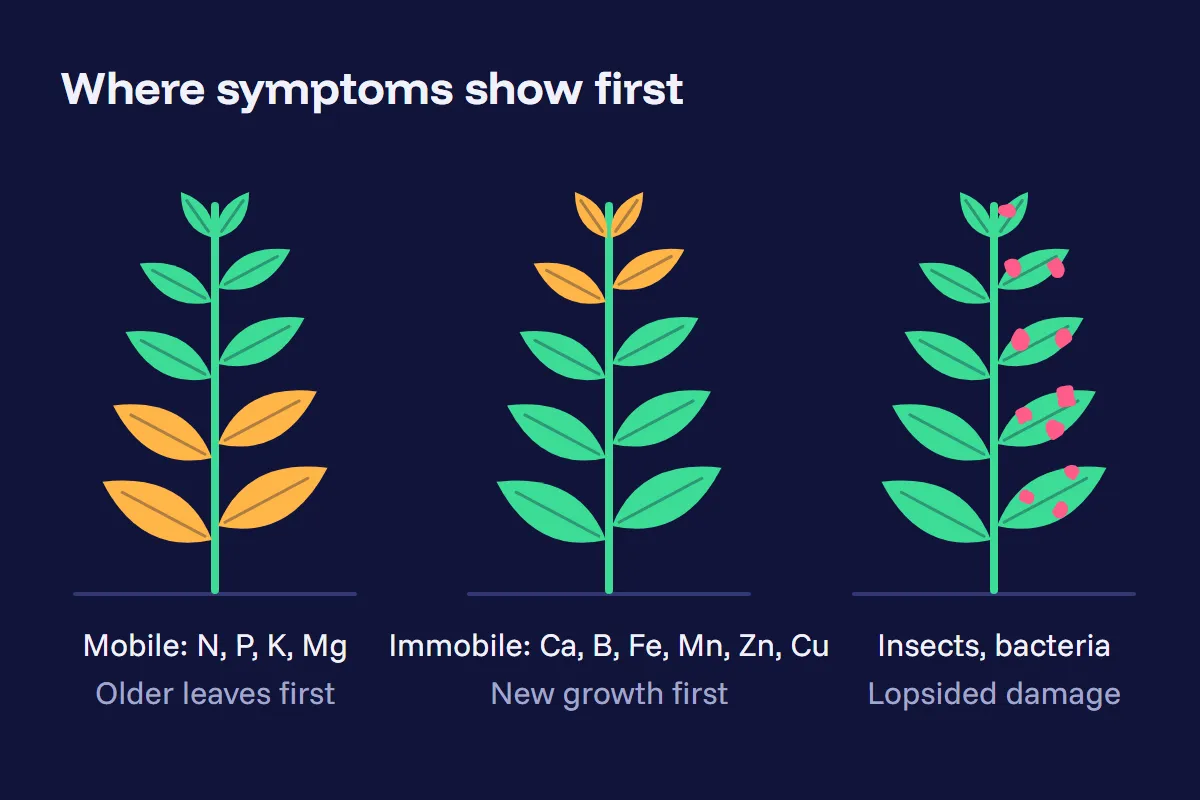 Where a symptom appears first narrows the list of causes, but it rarely names one. Source: University of Delaware Cooperative Extension.
A University of Wisconsin soil scientist describes the same sequence: start with one photo of the whole plant and one close-up of a leaf, and if that does not settle it, test soil and tissue from both affected and healthy plants. Even then, a low reading does not prove that nutrient caused the symptom.
Diagnostic labs see this daily. The University of Missouri plant clinic’s 2025 field crop report counts 522 physical and 259 digital submissions. On corn, the most frequent result was “no pathogen found”: 15 of 42 samples, ahead of any named disease. On soybean, 22 of 130 samples came back the same way. The clinic asks for photos first, then the plant itself. The deficiency in Anthropic’s video is the textbook case: no photo of a leaf could have shown what the soil was missing.
Anthropic’s own documentation tells you to verify Claude’s reading
The vendor’s manual is more cautious than its advertising. Anthropic’s vision documentation says Claude can make mistakes or hallucinate with low-quality or rotated images and with images under 200 pixels, and that its interpretations should be reviewed wherever the stakes are high.
Large photos are scaled down so the long edge fits 1,568 pixels, or 2,576 on Claude 4.7 and later models. A wide shot of a whole bed can therefore shrink a two-millimetre lesion to a handful of pixels. Send close-ups cropped to the symptom, and the overview as a separate image, rather than one big picture that tries to show everything.
In Quebec, a chatbot cannot write the pesticide prescription
The diagnosis is also where the rules start. In Quebec, the government’s agronomic prescription page, updated on 22 October 2026, says that class 1 to 3 products containing atrazine or one of three neonicotinoids (clothianidin, imidacloprid or thiamethoxam), applied from the ground or by aircraft, need a prescription from an agronomist, as does planting certain seeds coated with insecticide. Each prescription covers one crop on a parcel or group of parcels for up to a year, the seller needs a copy before selling the product, and the grower keeps it for five years. No chatbot answer replaces it, however convincing.
Quebec also offers the checks a chatbot cannot do. MAPAQ’s plant protection diagnostic lab, the LEDP, identifies diseases, insects and weeds, and since the 2026 season it has tested plant pathogens for fungicide resistance. The Réseau d’avertissements phytosanitaires publishes warnings by crop network, from strawberries to potatoes and crucifers, which is the short list of current suspects a chatbot should be working from.
AI plant disease diagnosis checklist: seven steps before you treat
The video’s real lesson is not that the chatbot knew the answer, but that a curious grower kept asking, noting and adjusting. These steps keep that habit and close the gaps the research shows.
- Photograph in layers. One shot of the whole plant, close-ups of the top and underside of an affected leaf, and one healthy plant for comparison, each sharp and sent as its own image.
- Give context before asking. Crop, variety, growth stage, the last two weeks of weather, fertiliser and spray history, and the date of your last soil test. A model that gathers this first does better, which is why an AI agent should ask clarifying questions before acting.
- Ask for a ranked list, not a verdict. Request the three to five likeliest causes, including non-living ones such as frost, drought, drift or deficiency, and what observation would tell each apart.
- Narrow it with local warnings. Check what the RAP is reporting for your crop and region, then ask again with that short list, leaving “none of these” open.
- Test before you spend. A soil test, a tissue test comparing healthy and affected plants, or a sample sent to a diagnostic lab costs less than a season of the wrong treatment.
- Treat only what is confirmed. For products under prescription, the agronomist decides the product, the rate and the timing.
- Log every photo, answer and outcome. This season’s notes are next season’s best prompt, and the record shows whether the chatbot’s suggestions actually helped.