Sharing a Claude Code Subscription With Your Team: The Terms
Sharing a Claude Code subscription with your team is now a setup step rather than a hack. Shared workspaces such as Kylon let one person connect their own Claude Code or Codex sign-in as an agent that colleagues can message, mention and hand work to. This article checks that arrangement against what Anthropic and OpenAI actually publish: their consumer terms, the Claude Code compliance page and the help articles on plan usage. It separates what those documents settle from what they leave open, then lists the setups that let a team share an agent without sharing an account.
The question comes out of a sponsored walkthrough of Kylon by Nate Herk, who runs a paid AI automation community and a small media team. His pitch is that most people still use AI alone. Each teammate has built a private stack of memory, skills and connected accounts, and those stacks only meet through shared tools like Google Drive or ClickUp, where data goes stale and work gets done twice. In his demo, his own Claude Code and Codex subscriptions sit in a chat channel next to two colleagues, take requests from all three people, and even trade messages with a hosted agent while nobody types. What the video never asks is whose plan pays for the colleagues’ requests, and whether that plan allows it.
A shared agent runs every request on one person’s plan
Kylon’s documentation is explicit about the mechanics. An agent brought from your computer “runs on your computer with its provider sign-in, files, and repositories, and becomes a workspace member you can message, @mention in Rooms, and assign work to” (Bring your own agent). The owner controls the door: a new agent starts private, and “only members listed here can talk to this agent” (Agent access).
Once a colleague is on that list, their requests run on the owner’s subscription. For Codex hosted on Kylon’s cloud, the documentation says so in one sentence: “Every message to this Agent runs on the owner’s ChatGPT account and counts toward that plan’s Codex usage” (Use your ChatGPT subscription). Claude Code connected from a laptop works the same way, since the agent is simply the owner’s signed-in Claude Code, reached through Kylon.
That explains a detail of the demo: the billing screen showed no Kylon credits spent by the subscription-backed agents. Kylon bills the workspace for its own hosting, connected tools and automations (Billing & credits). The model work behind those agents lands on a personal Claude or ChatGPT plan, whoever asked for it.
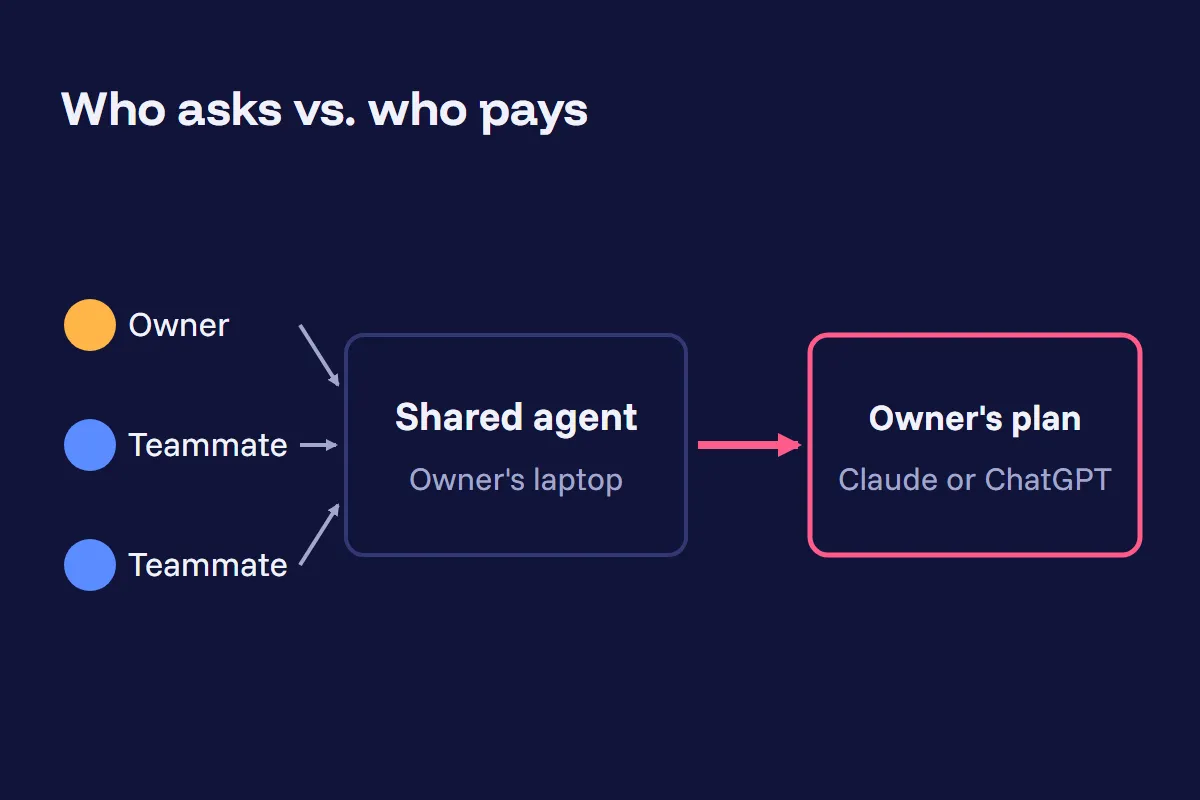 Who asks and who pays are different people: the shared agent spends the owner’s plan for every member on its access list. Mechanism described in Kylon’s agent documentation.
Both consumer terms forbid making your account available to others
Pro and Max subscriptions fall under Anthropic’s Consumer Terms of Service, not its commercial terms; the Claude Code legal and compliance page states that split directly. The Consumer Terms, effective October 8, 2025, contain two sentences that matter here:
“You may not share your Account login information, Anthropic API key, or Account credentials with anyone else. You also may not make your Account available to anyone else.” - Anthropic, Consumer Terms
OpenAI’s Terms of Use, effective January 1, 2026, say nearly the same thing in their registration clause: users “may not share your account credentials or make your account available to anyone else” and are responsible for everything done under the account.
Nobody in a Kylon setup hands out a password, so the first half of each clause is respected. The second half is the problem. An agent that a colleague can message at will, and that answers by spending your plan, is a fair description of an account made available to someone else. That reading is mine, not a ruling: neither company has published guidance on agents that several people talk to. But the plain words point one way, and nothing in either document points the other.
Anthropic sizes Pro and Max limits for one person
Anthropic’s Claude Code documentation adds a second signal. “Advertised usage limits for Pro and Max plans assume ordinary, individual usage of Claude Code and the Agent SDK,” the compliance page says, and subscription sign-in “is designed to support ordinary use of Claude Code and other native Anthropic applications.” A Max plan answering a five-person team is not individual usage in any ordinary sense of the word.
The same page also explains why Kylon’s method is not the one Anthropic has fought hardest. It bars third-party developers from routing requests “through Free, Pro, or Max plan credentials on behalf of their users” and from collecting Claude.ai tokens. Yet it does not prevent “an end user from signing in to the unmodified Claude Code binary with their own Claude subscription, including where a platform hosts Claude Code.” Kylon’s connection prompt runs inside your own Claude Code session and leaves the sign-in to Claude Code itself. The sign-in is clean. Who sends the work is the open issue.
Anthropic has shown that it enforces the individual-use line. On April 4, 2026, it stopped letting subscribers spend their plan limits in third-party harnesses, starting with OpenClaw, and Boris Cherny, who leads Claude Code, wrote that “subscriptions weren’t built for the usage patterns of these third-party tools” (TechCrunch). The compliance page also reserves the right to enforce its restrictions “without prior notice”. A team that builds its daily workflow on one person’s Max plan is betting that this line never moves toward shared agents.
OpenAI opened plans to other apps, not to other people
OpenAI has gone further than Anthropic in letting subscriptions travel. Its Sign in with ChatGPT program lets Go, Plus and Pro subscribers allow participating apps to draw on their plan, with a weekly cap per app set in ChatGPT’s settings. Kylon’s cloud-hosted Codex follows a related route: a one-time device code, which the ChatGPT account has to enable first.
Every part of that program is framed around the subscriber’s own requests. You sign in, you choose whether the app may use your plan, you set its cap. None of it rewrites the registration clause. OpenAI let your plan follow you into other apps; it did not let other people ride along on it. The per-person route exists on that side as well, since Codex is included across ChatGPT plans, Business and Enterprise among them.
The owner carries the risk, not only the bill
Both sets of terms make the subscriber answerable for what happens under the account: “You are responsible for all activity occurring under your Account,” in Anthropic’s wording, and OpenAI’s clause matches it. In a shared agent, that activity includes whatever a colleague asks for.
Kylon’s own warning makes the stakes concrete. A computer-based agent “runs as your operating-system user and can use files and tools available to that user,” and “Codex and Claude Code tasks do not wait for local permission prompts” (Bring your own agent). Anyone on the agent’s access list is therefore directing a process that holds the owner’s files, environment variables and logged-in accounts, with no confirmation step on the owner’s machine. A mistaken request, or a hostile instruction hidden in a document a teammate pasted, runs with the owner’s rights. Kylon states this plainly. The video presents the same property as a convenience: the agents need little onboarding because they already know their owner’s environment.
There is a practical cost too. A laptop agent is offline “when its computer is off, asleep, or disconnected from the network,” according to the same page, so the team’s shared agent vanishes whenever its owner closes the lid. Keeping it reachable means a machine left running for the team’s benefit, on one person’s account.
How to share Claude Code with a team without sharing an account
Four setups let a team work alongside the same agents while each request is billed to someone entitled to pay for it.
- One seat per person. Each colleague connects their own Claude Code or Codex sign-in as a separate agent, and the channel holds several agents instead of one borrowed one. Kylon supports this directly, and the video even shows a teammate who has not yet shared access to a subscription, which the host rightly treats as that teammate’s call. Claude Team costs $20 per seat per month billed annually, or $25 monthly, for 2 to 150 seats, and Team seats include Claude Code.
- An agent billed to the organization. Anthropic’s own shared agent, Claude Tag, is in public beta for Slack. In a channel it acts under service accounts that an owner provisions rather than as any member (agent identity), and “tagging Claude in a channel is billed to your organization.” Direct messages fall back to each person’s own plan.
- A company API key. The Claude Code compliance page allows a customer to configure an API key “for use by the customer’s own authorized users,” provided the usage is billed to the key owner and not resold. A shared agent running on a company key is the case the page describes.
- The workspace’s hosted agents. Kylon’s own agents spend workspace credits, so the bill reaches the workspace rather than a member’s personal plan.
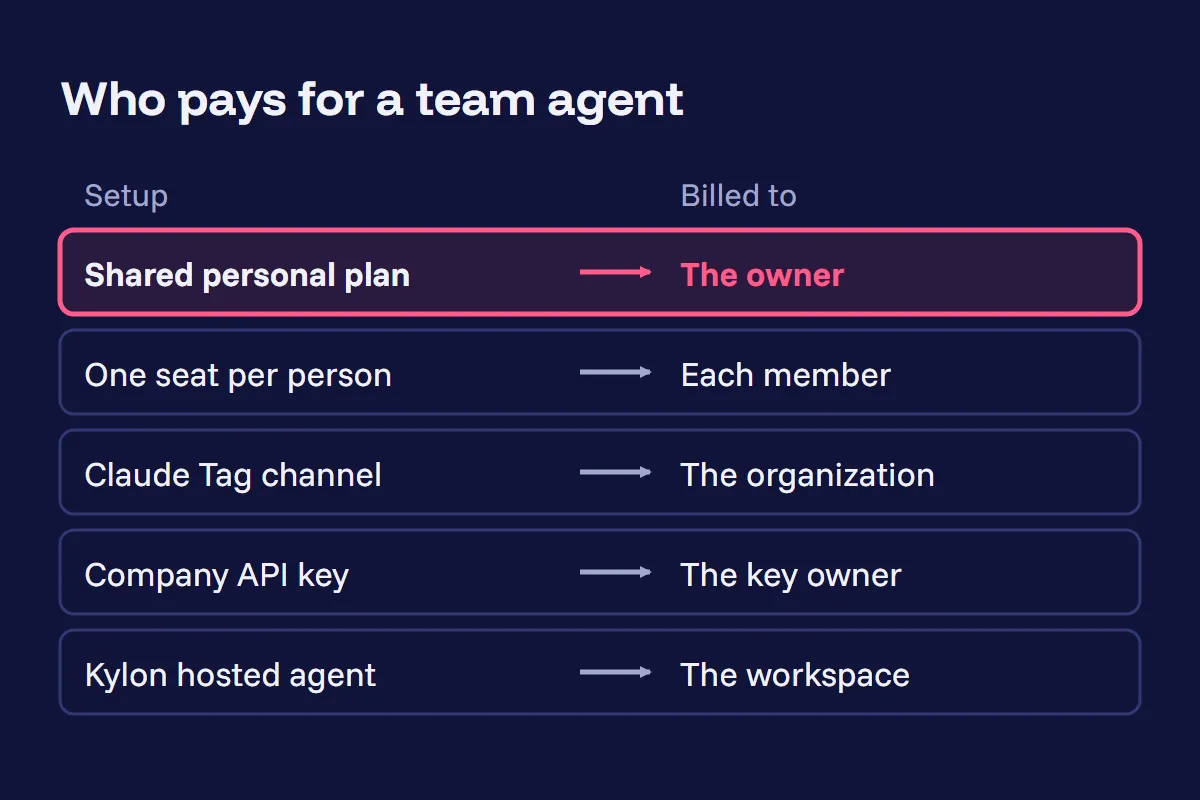 Only the first setup bills a whole team’s requests to one personal plan. Sources: Kylon documentation, the Claude Code compliance page and the Claude Tag support article.
The choice between the last three is ordinary procurement. Per-seat plans suit teams where everyone codes; organization billing suits a shared agent that answers requests from people who never touch a terminal. What none of them requires is a colleague’s personal subscription.
The sponsor’s demo proves convenience, not permission
Herk is candid about what the product adds:
“At the end of the day with Kylon, is it anything that we couldn’t have done beforehand? No.” - Nate Herk
He means it as praise. The same setup used to take custom apps, polling and deployment work, and now it takes a pasted prompt. That ease is the reason to read the billing line before inviting the team. Shared channels, shared apps and agents that talk to each other do not depend on a shared personal plan. They depend on one seat per person who sends requests, or on a bill addressed to the company.