AI Marketing Agent: Safe Write Access to Meta and Google Ads

Paid media automation used to mean bid rules and scheduled scripts. It now means an AI marketing agent: a general model such as Claude Code that reads campaign data, drafts ads and pushes changes to Meta and Google Ads on its own. This article explains why that agent should read from a data warehouse rather than from the ad platforms, why “write-only” access is a convention the APIs do not enforce, and which controls Meta and Google now offer to keep an agent away from the budget. It ends with seven checks to run before an agent touches a live account.
The recipe comes from Cody Schneider, a growth marketer who walked through his team’s setup on Greg Isenberg’s show this month. Ad, analytics, CRM and payment data flow into a warehouse, the agent queries only that copy, and the advertising APIs are used for writes alone: uploading creative, switching ads off, moving them between ad sets. Schneider also blamed the stories of agents getting ad accounts banned on bursts of thousands of requests. Schneider founded Graphed, which sells this infrastructure, so his claims deserve a check against what the platforms publish. Most of them hold. The part that does not is the idea that splitting reads from writes is enough to make the agent safe.
Meta and Google now let AI agents into ad accounts
The platforms have stopped treating agents as scrapers. Meta opened its ads AI connectors, an MCP server and a command line tool, in open beta on April 29, 2026, promising that agents could create and edit ads, ad sets and campaigns in natural language (Meta). On July 16, it added two things: connections from any AI application through an advertiser’s own developer app, and rules that let whoever has full control of a business portfolio restrict what agents may do on an ad account, from budget changes to catalog updates.
Google moved more cautiously. Its official Google Ads MCP server shipped read-only in October 2025. Version 0.0.6, released on November 2, 2026, added four write tools for assets and labels, enabled by default, but campaigns, budgets, bids and keywords are still out of reach (GitHub, PPC Land). Separately, Google retired developer tokens on September 9, 2026: API access levels now belong to a Google Cloud project, and brand verification is required before applying for Basic access (Google).
Both vendors are building agent access while keeping the budget behind a second lock. That is the design an in-house agent should copy.
Reading from a warehouse keeps raw reports out of the agent’s context
Schneider’s first rule is about data, and it holds up. An agent that calls the ad APIs directly pulls full reports into its context, where they crowd out the task, invite invented numbers, or push the agent to improvise a local database full of duplicates. Anthropic made the same point about tool use in general: every intermediate result passes through the model, and in one example, keeping the data in the execution environment cut a task from about 150,000 tokens to 2,000 (Anthropic, November 4, 2025).
A warehouse turns that principle into infrastructure. Airbyte’s Facebook Marketing connector syncs campaigns, ad sets, ads and ad insights on a schedule (Airbyte), and its ClickHouse destination, tested against ClickHouse 26.7, lands them next to CRM and payment tables (Airbyte). The agent then runs SQL and gets back the five rows that matter, not five thousand. It can also join an ad to revenue and customer lifetime value, which no single ad platform can show.
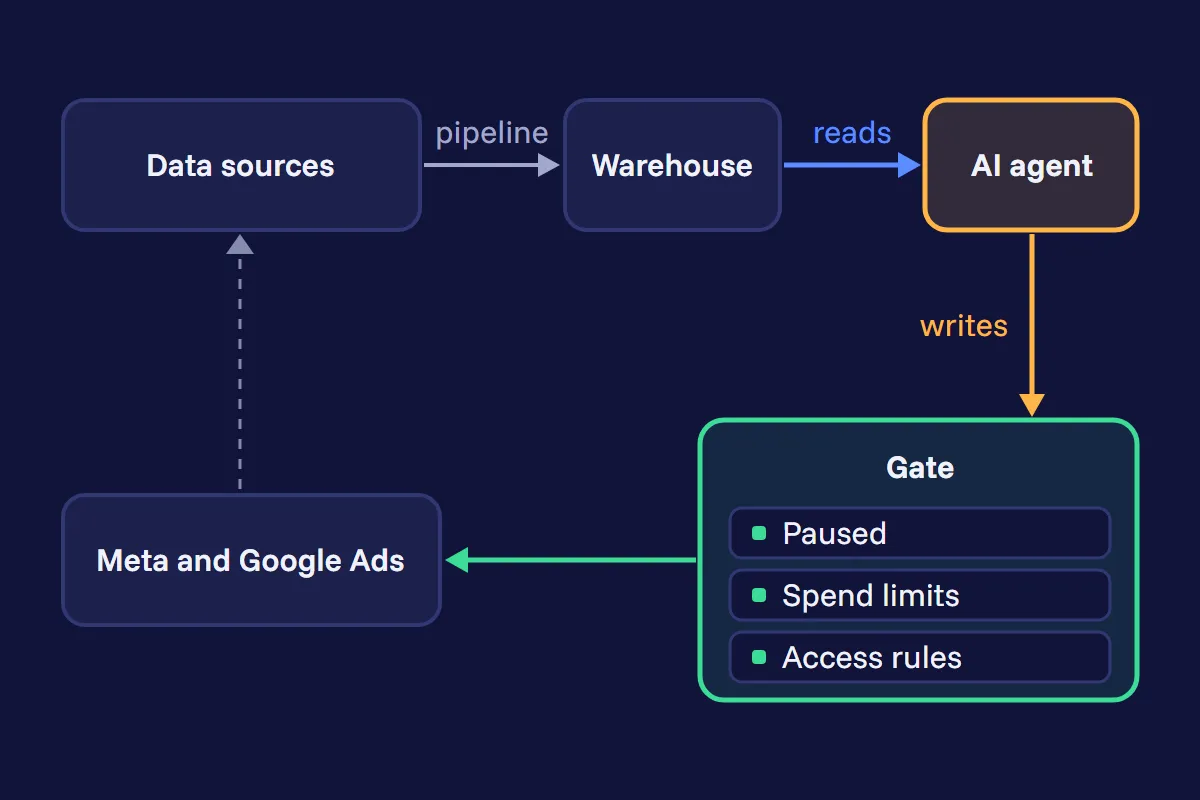 Reads come from the warehouse copy, writes go to the ad platforms through a gate. The gate is the part the APIs do not provide by themselves.
Meta’s rate limits are per ad account, and writes cost triple
The second reason to keep reads off the ad APIs is that they share a budget with writes. Meta computes Marketing API quotas per ad account. The hourly Ads Management allowance is 300 calls plus 40 per active ad for an app in the development tier, and 100,000 plus 40 per active ad with full access (Meta). In the separate per-app score, a read costs one point and a write costs three.
The same page lists the limits an agent loop actually hits:
- 100 create or edit requests per second, per app and ad account.
- One edit per object every 30 seconds by default.
- An ad set budget changed more than four times in an hour is rejected.
- An account spending limit changed more than ten times in a day is rejected.
The documented penalty for exceeding them is throttling, with blocks of 60 to 300 seconds depending on the tier. Meta’s documentation does not tie rate-limit errors to account bans, and Schneider offered no evidence that bursts cause them. The safer reading is narrower: an agent retrying in a tight loop wastes its quota and leaves half-finished changes, which is reason enough to design for the limits.
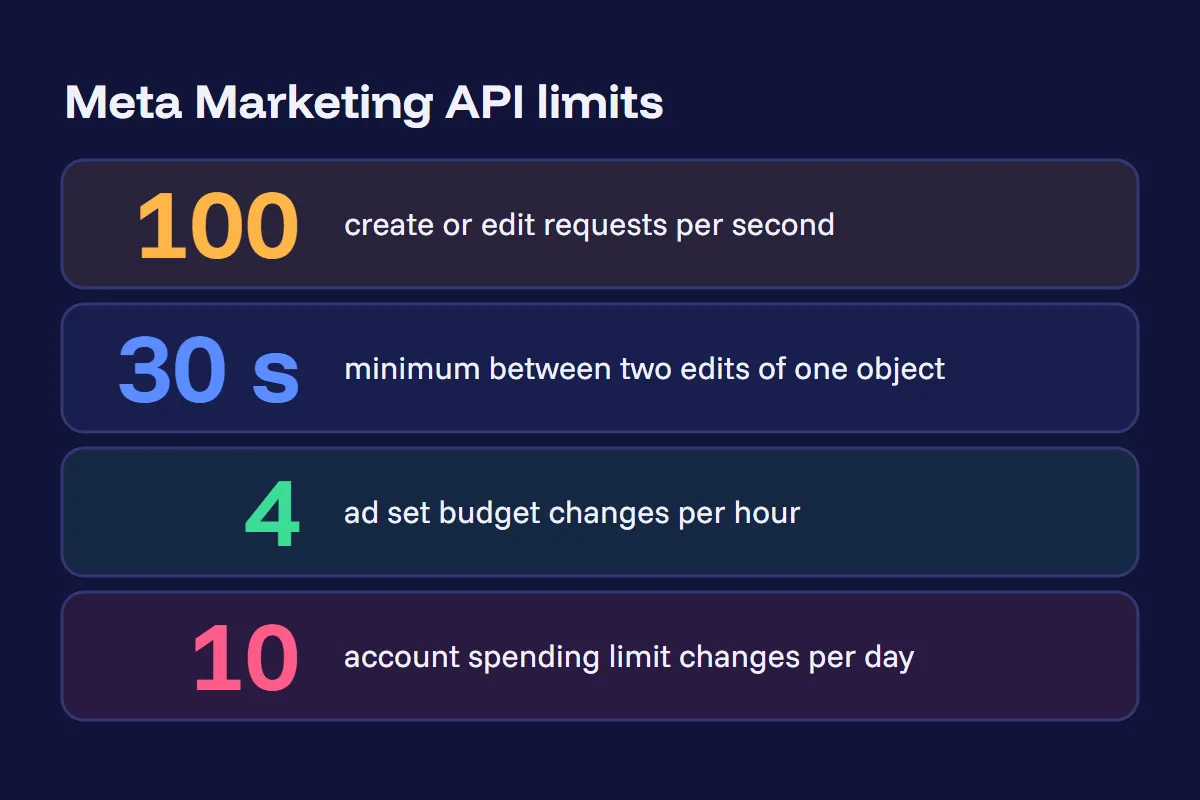 The limits in Meta’s rate limiting documentation that an agent loop is most likely to hit.
Write-only is your convention, not the API’s
Here the episode’s architecture needs a correction. “The agent only writes” describes how the code is meant to behave, not what its credentials allow. Neither platform issues a token that can create ads but not read the account, so nothing stops an agent with ad management rights from also pulling reports, raising a budget or deleting a campaign it was never meant to touch.
On Google, the limit is the role of the user behind the credentials. Google Ads defines five access levels: Read-only users can view campaigns and run reports, Standard users can also edit campaigns and billing information, and only Admins can grant access or change other users’ levels (Google). An agent connected through an Admin’s login inherits all of it. The fix is a dedicated identity per job: a Read-only user for anything that reports, a Standard user for the writer, and never an Admin.
The research step makes the separation more urgent. In the static ad workflow Schneider demonstrated, the agent reads Reddit threads and competitors’ ad libraries to find customer pain points. That text is written by strangers, and an agent that reads it while holding the keys to an ad account combines untrusted input with the power to act on it. A research agent with no ad credentials, handing a brief to a writer agent that never browses, removes that combination at little cost.
This is the same lesson as with any shared agent: AI agent permissions have to be enforced outside the model, because a prompt that says “only write” is a request, not a control.
Paused by default turns each agent action into a proposal
Meta’s API accepts only two statuses when an ad is created, active or paused, and its reference page recommends paused during testing to avoid accidental spend (Meta). Making paused the only status an agent may use converts every creation into a draft that a person switches on. Google’s MCP server bakes a similar step into its write tools: each change is first validated without effect, and the second call must carry the checksum the first one returned.
That review gate is where Schneider and Isenberg agreed a human belongs: someone looks at the batch before it goes live, ideally after an agent has scored it. It is also where the checks that no algorithm optimizes for belong, such as whether an avatar is presented as a customer, a problem covered in AI UGC ads and fake testimonials.
Spending limits belong to the account, not to the prompt
A budget instruction in a prompt is a suggestion. A spending limit in the ad account is a wall. On Meta, the account spending limit is a lifetime cap set in the billing settings; once it is reached, every campaign in the account stops spending (Jon Loomer). Campaign spending limits add a ceiling per campaign. Meta’s new MCP server rules go further for agents connected that way, letting the portfolio owner forbid budget changes outright.
Google’s official server simply has no budget tool. If an in-house agent needs to adjust budgets, it should do so within a range set by a person, and through an identity whose changes are logged.
Narrow jobs beat a general marketing agent
Schneider was blunt about what failed in his own trials:
“you don’t need God in a box to run a Facebook ads account”
- Cody Schneider, on Greg Isenberg’s podcast
His better example was narrow. A Google Ads agent checks each search term against the landing page it triggers and flags the ones without buying intent, auditing 5,000 terms in 20 seconds by his account. That job reads a lot and writes almost nothing, which makes it the right first step. Autonomy can then grow in stages: reports first, then proposals, then paused drafts, and only then live changes inside a cap. The AI agent harness around the model, meaning its data, tools and permissions, matters more than which model sits inside it.
AI marketing agent checklist: seven controls before it spends
- Separate reads from writes in infrastructure. Reporting goes through a warehouse sync, not through the agent’s ad credentials.
- Give each job its own identity. Read-only for reporting, Standard for the writer on Google, never an Admin login.
- Create everything paused. A person, or a rule a person wrote, switches ads on.
- Set an account spending limit. On Meta, a lifetime cap stops every campaign when it is reached, whatever the agent decides.
- Lock budget changes. Use Meta’s MCP server rules where available, and keep budget edits out of the agent’s tools elsewhere.
- Respect the documented limits. Spread requests, batch them and back off, rather than retrying in a loop.
- Log every change with its author. When an ad set misbehaves, you need to know whether a person or an agent changed it, and when.
An AI marketing agent built this way can test more creative and watch more search terms than any team, and the worst it can do is propose something wrong.